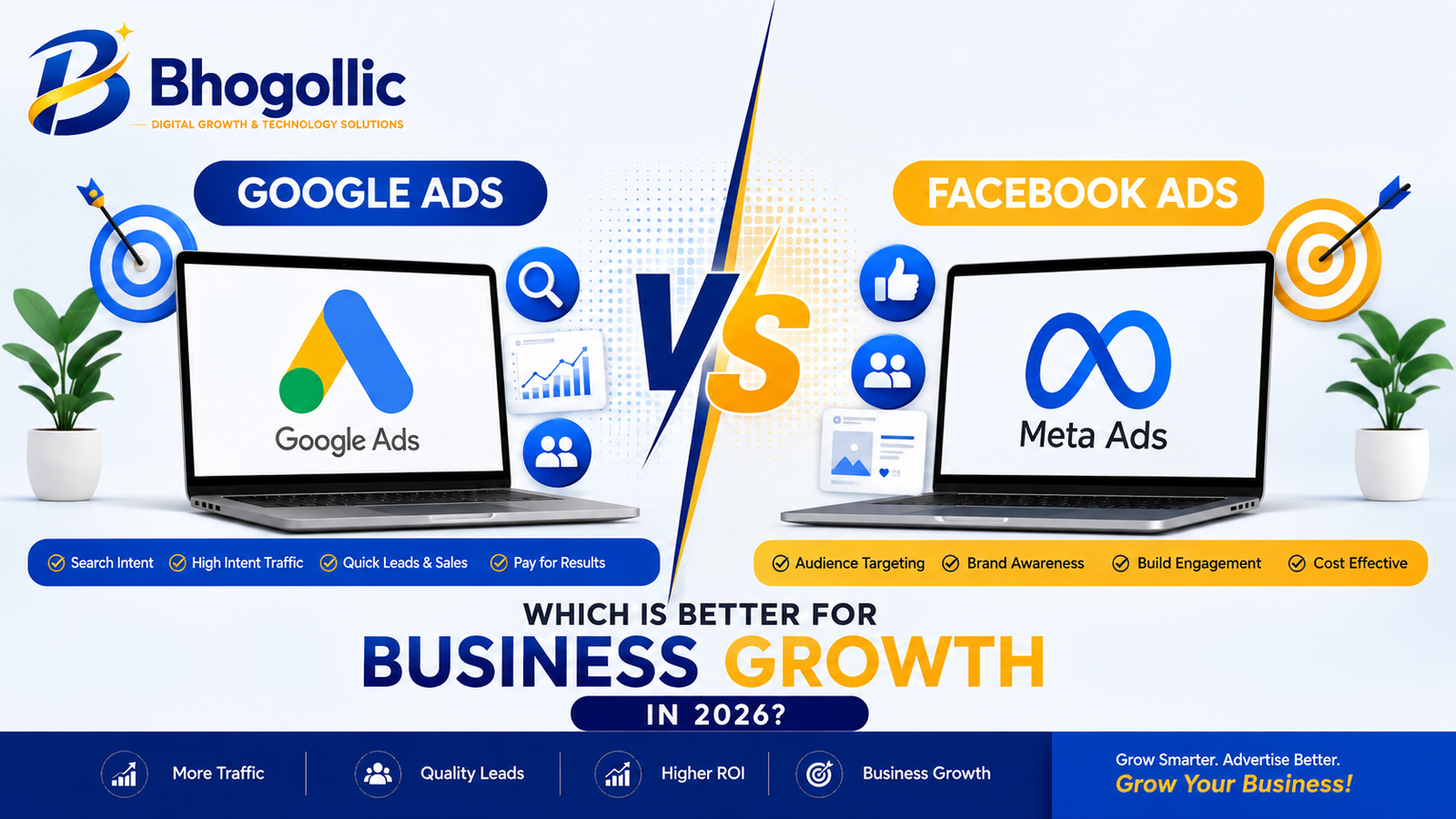
Google Ads Vs Facebook Ads: Which Is Better For Business Growth In 2026?
Digital advertising has become an important part of business growth. Whether you run a local business, service company, e-commerce store, startup, or established brand, choosing the right advertising platform can directly affect your leads, sales, and marketing budget.
Two of the most widely used platforms are Google Ads and Facebook Ads, now commonly managed through Meta's advertising ecosystem. However, they work differently. Google generally helps businesses reach people who are already searching for a product or service, while Facebook and Instagram can help businesses reach relevant audiences before they actively search.
So, which one should your business choose in 2026?
The answer depends on your business goals, audience, industry, budget, customer journey, and conversion strategy.
Google Ads vs Facebook Ads: The Main Difference
The simplest way to understand the difference is search intent versus audience discovery.
Google Ads can capture existing demand. For example, someone searches for “website development company in India” or “SEO services near me.” A relevant advertisement can appear when that person is actively looking for a solution.
Facebook and Instagram advertising generally work differently. Instead of waiting for someone to search, businesses can introduce products or services to selected audiences based on available targeting signals and campaign objectives.
This makes Google particularly useful for capturing high-intent searches, while Meta advertising can be effective for awareness, discovery, remarketing, lead generation, and visually driven campaigns.
How Google Ads Works for Businesses
Google Ads allows businesses to promote their products and services across Google's advertising ecosystem. Search campaigns are especially useful when customers are actively looking for a solution.
For example, a web development company might target searches related to:
- Website development company
- Website development services
- Business website development
- WordPress website development
- E-commerce website development
The advantage is that the audience can already have a specific requirement.
A properly managed campaign can combine relevant keywords, compelling ad copy, location targeting, conversion tracking, negative keywords, landing-page optimization, and ongoing performance analysis.
This is where professional Google Ads management becomes important. Simply creating an advertisement does not guarantee profitable leads.
How Facebook Ads Works for Businesses
Facebook Ads, together with Instagram advertising through Meta, is particularly useful for reaching defined audiences and generating interest around a business, product, service, or offer.
For example, a digital agency could create campaigns promoting:
- Website design
- SEO services
- Social media management
- Google Ads management
- Branding
- E-commerce development
Instead of depending entirely on search queries, businesses can use creative content to communicate a problem, introduce a solution, demonstrate benefits, and encourage users to take action.
This makes Facebook Ads agency and Meta Ads services useful for businesses that need awareness, lead generation, remarketing, and creative-based customer acquisition.
Google Ads vs Facebook Ads for Lead Generation
For lead generation, neither platform is automatically better for every business.
Google can be particularly valuable when customers already know what they need. Someone searching for “SEO company in India” has expressed a clear commercial interest.
Facebook and Instagram can be useful when businesses need to create demand or reach potential customers who match their target audience but may not yet be searching for the service.
Recent 2026 industry comparisons continue to describe this fundamental difference as Google capturing existing intent while Meta platforms are stronger for discovery and demand creation.
The quality of the landing page, offer, targeting, creative, follow-up process, and conversion tracking can matter just as much as the advertising platform.
Which Platform Is More Cost-Effective?
Advertising cost varies significantly by industry, location, competition, audience, campaign objective, quality, and conversion rate. Therefore, businesses should avoid choosing a platform simply because its average cost per click appears lower.
A cheaper click is not necessarily a cheaper customer.
For example, a campaign generating 100 inexpensive clicks but no qualified enquiries may be less valuable than a campaign generating 20 highly relevant clicks and several genuine leads.
Instead of focusing only on CPC, businesses should monitor:
- Cost per lead
- Qualified leads
- Conversion rate
- Customer acquisition cost
- Sales generated
- Return on ad spend
- Revenue generated
This approach gives a much clearer picture of advertising performance.
Google Ads vs Facebook Ads for Local Businesses
Local businesses can benefit from both platforms.
Google Ads can help capture searches such as “digital marketing agency near me,” “website developer in Delhi,” or other location-specific service searches.
Meta advertising can help local businesses promote offers, services, events, products, and brand awareness to relevant audiences.
For a local business, location targeting, landing-page relevance, Google Business Profile visibility, compelling creative, WhatsApp or call options, and fast lead follow-up can work together to improve results.
Which Platform Is Better for E-commerce?
E-commerce businesses can also use both platforms, but the strategy may differ.
Google can capture people actively searching for products and can support shopping-focused advertising strategies.
Meta can be useful for product discovery because visually attractive images and videos can introduce products to potential customers. Retargeting can also help reconnect with people who previously interacted with a brand.
For e-commerce, businesses should connect advertising with product pages, strong product descriptions, pricing, offers, reviews, shipping information, and a simple checkout process.
Should You Use Google Ads or Facebook Ads?
Instead of treating Google Ads and Facebook Ads as direct competitors, businesses can use them at different stages of the customer journey.
A practical strategy can look like this:
Google Ads → Capture existing demand → Generate high-intent traffic → Convert enquiries
Meta Ads → Build awareness → Generate interest → Retarget audiences → Generate leads or sales
When both channels are managed properly, they can complement each other rather than compete for the same purpose.
What About a Limited Advertising Budget?
Businesses with limited budgets should not immediately divide their budget equally between both platforms.
First, identify where the strongest opportunity exists.
If people are actively searching for your service, Google Search Ads may deserve priority.
If your product or service needs visual presentation, awareness, audience building, or demand generation, Meta advertising may be a stronger starting point.
The right approach is to test, measure, optimize, and then scale the channel producing the best qualified results.
Why Professional Ad Management Matters
Successful digital advertising requires more than launching campaigns.
A professional advertising process can include:
- Audience and keyword research
- Competitor analysis
- Campaign structure
- Ad copy development
- Creative testing
- Landing-page review
- Conversion tracking
- Budget optimization
- Negative keyword management
- Audience optimization
- Remarketing
- Performance monitoring
- Lead-quality analysis
Continuous optimization is important because advertising performance changes as audiences, competitors, search behavior, creative performance, and market conditions change.
Google Ads vs Facebook Ads: Final Verdict
So, which is better for business growth in 2026?
There is no universal winner.
Choose Google Ads when your customers are actively searching for your products or services and your priority is capturing existing demand.
Choose Facebook/Meta Ads when you want to build awareness, reach specific audiences, promote visual content, generate interest, or create demand.
Use both when your business needs a broader digital advertising strategy.
The most important factor is not simply choosing Google or Facebook. It is creating a complete system where the advertisement, audience, offer, landing page, tracking, sales process, and follow-up work together.
For businesses looking for Google Ads agency, Facebook Ads agency, Meta Ads services, or professional Google Ads management, Bhogollic can position its digital advertising services around this complete growth approach—helping businesses attract the right audience, generate qualified enquiries, and turn advertising traffic into measurable business opportunities.
People Also Ask / FAQs
Which is better, Google Ads or Facebook Ads?
Both platforms can be effective, but the better option depends on your business goals, target audience, and customer journey. Google Ads is particularly useful for capturing existing demand because users are already searching for products or services. Facebook Ads and Instagram advertising are useful for reaching targeted audiences, building awareness, generating interest, and creating demand. A professional Google Ads agency can identify high-intent keywords and optimize campaigns, while a Facebook Ads agency can use audience targeting, creative testing, and remarketing. For many businesses, using both platforms together can create a stronger digital advertising strategy.
What does a Google Ads agency do?
A professional Google Ads agency manages the complete advertising process, from research and campaign setup to optimization and performance tracking. This can include keyword research, competitor analysis, campaign structure, ad copy, location targeting, negative keywords, conversion tracking, landing-page recommendations, budget management, and ongoing optimization. Google Ads management focuses on improving campaign efficiency rather than simply generating clicks. The goal is to attract relevant users, generate qualified leads, control unnecessary advertising costs, and improve conversions over time.
What are Meta Ads services?
Meta Ads services include paid advertising across platforms such as Facebook and Instagram. Depending on the business objective, campaigns can be created for lead generation, awareness, engagement, website traffic, conversions, remarketing, and other marketing goals. A professional Facebook Ads agency can help with audience research, campaign setup, creative strategy, ad copy, testing, retargeting, budget optimization, and performance analysis. Meta advertising can be especially useful for businesses that need to introduce their products or services to potential customers who may not yet be actively searching for them.
Is Google Ads better for getting leads?
Google Ads can be highly effective for lead generation when customers are actively searching for a particular service or product. For example, someone searching for “SEO services India” or “website development company” may already have a strong commercial requirement. However, lead quality depends on several factors, including keyword selection, ad relevance, landing-page quality, targeting, conversion tracking, budget, and sales follow-up. Professional Google Ads management can continuously analyze these factors and optimize campaigns toward more relevant and qualified leads instead of focusing only on the number of clicks.
Should businesses use Google Ads and Facebook Ads together?
Yes. Using both platforms can create a more complete digital advertising strategy because they can serve different stages of the customer journey. Google Ads can capture people who are already searching for a solution, while Meta Ads services can help businesses build awareness, reach targeted audiences, generate interest, and remarket to previous visitors or prospects. A Google Ads agency and Facebook Ads agency can test both channels and compare metrics such as qualified leads, conversion rate, customer acquisition cost, and revenue. The best strategy is to allocate budget according to actual business results rather than automatically splitting the budget equally.
Recent Posts